Research methodology
Methodology as a chain of reasoning
Research methodology has a vocabulary that can initially feel abstract. The terms are easier to understand when you see them as connected questions rather than definitions to memorise.
A useful metaphor to visualise research design is an iceberg. At the top, easy to see, are your methods. Further down, below the surface, are the layers or reasoning that shape them.
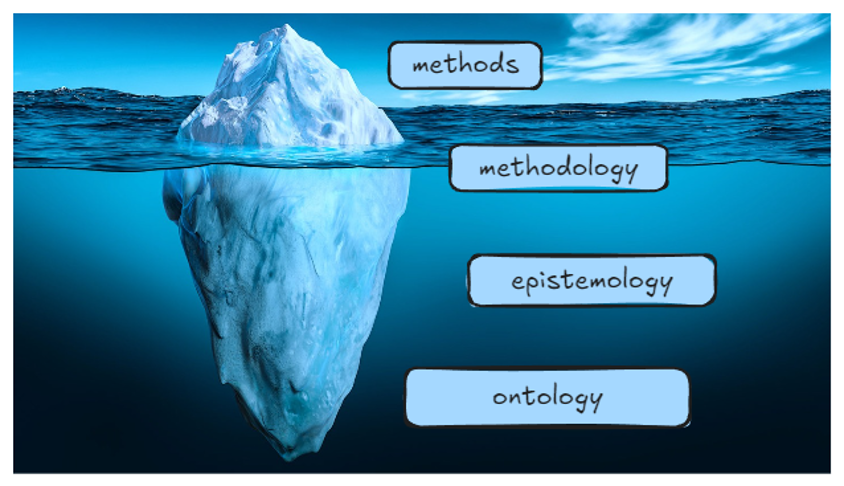
All four layers are always present in a study, whether or not you have named them explicitly. Thinking about them deliberately can to lead more coherent and defensible research.
| Layer | The question it answers | In plain terms |
|---|---|---|
| Methods | What specific tools and techniques will I use to collect and analyse data? | Interviews, surveys, experiments, statistical tests, thematic analysis |
| Methodology | What is my overall strategy or design, and why is it right for my question? | The reasoning that connects your question to your methods |
| Epistemology | How can I come to know about this, and what counts as good evidence? | What makes a claim trustworthy in your study |
| Ontology | What kind of thing am I studying? What is its nature? | Is it something that exists independently of people’s views, or is it shaped by them? |
Core terms
Paradigm: What overall lens shapes your research?
A paradigm is commonly used as a summary label for a researcher’s way of understanding the world and studying it. It encompasses positions on ontology, epistemology, methodology and methods, which are explained in more detail below. It can be thought of as a lens that shapes what a researcher notices, what questions they ask, what they accept as evidence, and how they interpret findings.
Paradigm labels can be useful, but they are not substitutes for reasoning. Rather than only naming a paradigm, you need to explain how your assumptions and choices fit your project.
The sections below break a paradigm down into its component parts.
Ontology: What is the nature of the phenomenon?
In philosophy, ontology concerns what fundamentally exists. In research methodology, it is often used in a narrower, applied way. It asks what kind of phenomenon you believe you are studying.
Three common ontological positions are:
- Realism. There is an external reality that exists independently of our perceptions of it, and it can be investigated.
- Constructivism. Reality, or at least the social phenomena we study, is shaped by human experience, culture and interpretation.
- Critical realism. Holds that an independent reality exists, but that our knowledge of it is always partial and shaped by the observer’s perspective and context.
Epistemology: What counts as knowledge?
Epistemology concerns how knowledge can be developed and justified.
It asks questions such as:
- What would count as convincing evidence?
- Can a phenomenon be measured directly?
- What can participants’ accounts tell us?
- How should competing interpretations be evaluated?
- What makes a finding trustworthy?
Methodology: What is the logic of the study?
Methodology is the overall strategy and reasoning that connects your question to your research design. It explains why a particular way of investigating the phenomenon is appropriate.
Methodology is therefore more than a list of procedures. It provides a rationale for how knowledge will be developed.
Methods: What will you do?
Methods are the practical techniques used to collect and analyse data. They include:
- interviews;
- surveys;
- experiments;
- observations;
- document analysis;
- reading assessments;
- statistical analysis; and
- thematic analysis.
A method does not automatically belong to one philosophical position. Interviews, for example, can be used to investigate participants’ meanings or as evidence about causal processes. What matters is how the method is used and what role the resulting data play in the argument.