GRASP
From the Valley of Despair to the Plateau of Sustainability
September 23rd, 2026, by
One year at Thesis Fest there was a panel discussion called “Tales from the Valley of Despair,” where HDR students were invited to talk about the challenges of the HDR journey. The name comes from a popular internet meme depicting confidence over time as you learn something new: an early burst of enthusiasm, followed by a dip into the “Valley of Despair” as reality sets in, before a slow climb back out.
Where “the Valley of Despair” comes from
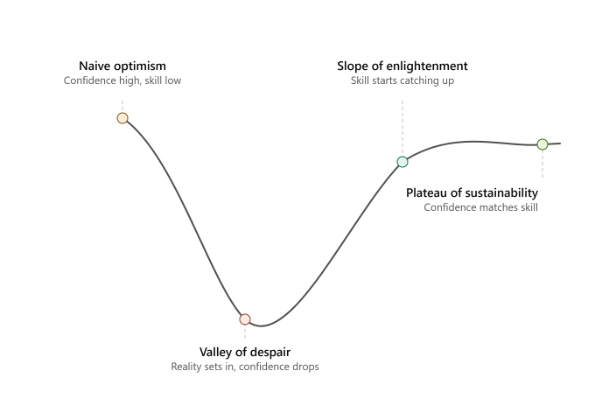
The “Naive Optimism → Valley of Despair → Slope of Enlightenment → Plateau of Sustainability” visual is internet folklore that is referred to as the “Dunning-Kruger” effect (although it’s worth noting the curve itself doesn’t actually appear in Dunning and Kruger’s original 1999 psychology research - their work was narrower, identifying a cognitive bias whereby people with little skill in a domain tend to overestimate their competence, while genuine experts often underestimate theirs). The shape of the curve closely resembles another well-known model, Gartner’s “Hype Cycle,” used to describe how expectations around new technologies rise, crash, and eventually recover.
A closer fit for what the curve is actually trying to describe is the “Conscious Competence learning model”, which maps out four stages anyone goes through when learning a new skill:
- Unconscious Incompetence - you don’t know what you don’t know. Confidence is high because you can’t yet see the scale of the challenge. This is similar to “Naive Optimism.”
- Conscious Incompetence - you now realise how much you don’t know. Confidence drops as the gap between your ability and the task’s demands becomes painfully visible. This is the “Valley of Despair”.
- Conscious Competence - you can do the skill, but it takes deliberate effort and concentration. This is the “Slope of Enlightenment”: progress, but not yet automatic.
- Unconscious Competence - the skill becomes second nature. This is the “Plateau of Sustainability”.
Whichever version of the model you prefer, the shape of the experience is the same, and I’m sure you can relate to this trajectory as describing your own research journey: the initial enthusiasm, excitement and self-confidence that sustains you at the start, followed by the challenges and obstacles that wear you down or make you feel stuck. But what about the progress up the other side, to reach the plateau and then the finish line? Why do we end up feeling stuck for so long in the Valley of Despair, unable to see a way out, despite consistent hard work?
Why you can feel stuck despite working hard
Concept artist Antonio Stappaerts over at the Artwod Blog offers a useful explanation for why we can feel stuck in the Valley of Despair despite sustained, consistent effort. He points out that a long-term goal isn’t one climb, but many. It requires a whole portfolio of sub-skills built up over time. For an artist, this might be drawing, composition, lighting, and colour theory. For an HDR student, it might be learning new software, mastering the norms of academic writing, writing a literature review, conducting interviews, and analysing data.
Stappaerts argues that this means the learning cycle above repeats constantly, and often invisibly. You start learning a new skill such as a particular data analysis package, hit the frustrating “valley” stage, and rather than push through, you switch your attention to a different task such as finishing your literature review, while telling yourself you’re still making progress. It’s true that you are working hard, but because you keep abandoning tasks right at the point where real learning would happen, you never actually climb out of any single valley - you just keep re-entering new ones. The result: you feel stuck, frustrated and demotivated, despite genuinely putting in the hours. You’d expect to be at least somewhere on the Slope of Enlightenment by now. Instead, you feel exactly where you started.
What to do if you feel yourself in this situation
It’s important not to stay too long in the Valley of Despair, feeling burnt out and demoralised. But the answer isn’t to quit the task you’re finding difficult and jump to something easier, as that’s the pattern that keeps you stuck. To get good at something you need to keep pushing through, facing the hard stuff, and feeling the uncomfortable feelings of uncertainty and low confidence, trusting that you’ll get better at it if you persevere.
A few concrete things that help:
- Name it. Recognising “I’m in the Valley of Despair with this particular skill” is itself useful as it turns a vague sense of failure into a known, temporary stage.
- Commit to one thing at a time. Rather than bouncing between five half-mastered skills, pick one and stay with it long enough to reach the other side.
- Talk to someone. Your supervisor, peers, or fellow HDR students have almost certainly been through their own version of this valley — you don’t have to navigate it alone.
If you’re finding that the difficulty has tipped over into something more than the normal ups and downs of learning such as ongoing burnout, or a sense of despair you can’t shake, it’s worth reaching out to others for support, including Curtin’s counselling and wellbeing services. Its not a sign you’re not cut out for this; many HDR students experience it and understanding the journey as made up of many intertwined, smaller learning journeys can help navigate this challenging terrain.
Please make any anonymous comments/ feedback, or suggestions for further posts at this link. If you would like to get in touch or write a post for the Ideas Hub blog, please email karen.miller@curtin.edu.au. Contributions from HDR students are welcome!
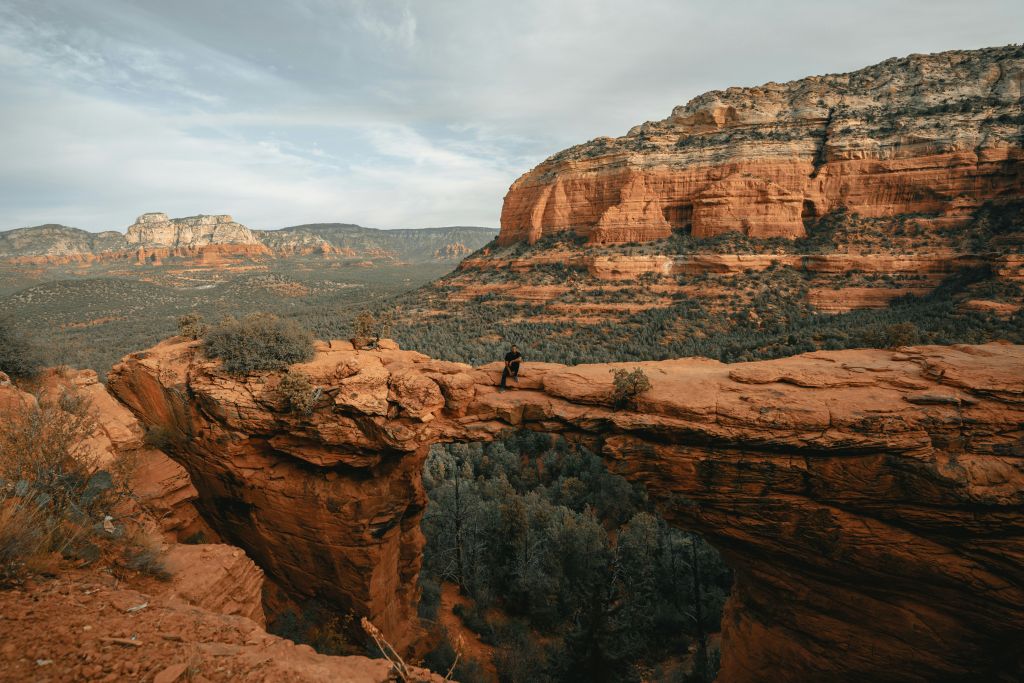
Image by Clay Banks on Unsplash