The joy of the planner - Time management as a creative practice
September 16th, 2026, by

Open my planner on any given month, and you won’t just find due dates and supervisor meetings. You’ll find mushrooms drawn in the margins, washi tape marking a “rest day,” a little illustrated figure lying down after a long week, and stickers celebrating things as small as a haircut or as significant as a thesis draft being due. Chapter deadlines sit next to doodles. A “writer meetup” is marked in soft purple. Even my ink pads and stamps live on my desk like part of the toolkit, alongside the notebook itself.
I did not start this way. For the first few months of my MPhil, I used the planner exactly as it was designed: dates, deadlines, and ticks. It felt tidy and efficient, right up until the week everything piled up at once, and the tidy list stopped meaning anything. It just sat there being ignored. What changed things was almost an accident. I picked up an ink pad meant for a completely different project, tested a stamp in the margin of a page I had already messed up, and reached for a sticker instead of rewriting a note I had crossed out twice. That first small mark did something a checklist never had: it made the page feel like mine, not just a schedule imposed on me. From there, the mushrooms, the washi tape, and the resting figures all followed.
For a long time, I thought of this as a slightly indulgent habit, something separate from the “real” work of managing a research degree. Lately, I’ve come around to a different view: decorating isn’t separate from time management; it’s part of what makes time management sustainable. However, it’s also worth being honest that decoration alone doesn’t get a thesis written, so this is as much about the actual mechanics of planning a research degree as it is about the mushrooms in the margins.
Planning as more than admin
Most conversations about productivity treat planning as a purely functional task: write down the deadline, tick it off, move on. However, there’s a reasonable body of writing suggesting that the act of organising a to-do list can do more than just remind you what’s due. One overview of journaling for mental health notes that a study found that writing a descriptive to-do list before bed helped people fall asleep faster than simply reflecting on the day’s completed tasks (HelpGuide, 2026). There’s something almost obvious about this once you sit with it: externalising what’s in your head, even in a small, structured way, seems to quiet it down.
Bullet journaling, in particular, has been described as a hybrid of a diary, planner, habit tracker, and goal-setting system, one that intentionally leaves room for individual customisation rather than a fixed template. Writers on the topic consistently point to a few recurring benefits: it declutters the mind by moving tasks out of your head and onto the page, and it helps keep you grounded in the present rather than spiralling about everything still ahead of you (Self-Love Therapy LLC, 2024).
Why the decoration isn’t a distraction
The part that resonates with me most, though, isn’t the organisational structure, it’s the creative layer sitting on top of it. Several writers on bullet journaling describe the customisable, decorative side of the practice as a genuine creative outlet in its own right, not just decoration for its own sake (Self-Love Therapy LLC, 2024; Manning, 2021). One writer described planning a new monthly theme, watching other people’s planner videos for inspiration, and then mapping out her own pages as a cathartic process that quieted her mind, precisely because it required just enough focus to crowd out anxious thoughts without demanding the kind of mental effort that feels overwhelming on a hard day (Weagle, 2019).
That tracks closely with how I use my own planner. Some weeks, a chapter deadline gets a bold folder tab and a note in red pen because it matters, and I want to feel that. Other weeks, drawing a small mushroom border or adding a sticker of a character sprawled out resting is the whole point, a five-minute act of care that has nothing to do with productivity and everything to do with making the page, and the week, feel survivable.
The ink pads and stamps matter here more than they probably should. There is a small, specific ritual to it: opening the tin, testing the stamp on scrap paper first, choosing a colour that matches the mood of the week rather than the mood of the deadline. It takes maybe two minutes, and those two minutes function as a kind of threshold between the admin brain and the rest of the evening. I have come to think of it less as decorating a to-do list and more as a small, repeatable act of self-care that happens to live within a planning system, much like some people use a cup of tea or a short walk to mark the end of a work block. The page gets a mushroom. I get a pause.
This is also where creators like TheCoffeeMonsterzCo come in for me. Watching planning and journaling content isn’t just about picking up layout ideas, it’s part of a wider, informal community of people treating their planners as a genuine creative practice rather than a chore, which is exactly the spirit one writer captured when describing how she loves playing around with pretty pages and doodling mindfully, treating her planner as a space where creativity and productivity meet rather than compete (Rees, 2019).
What actually helps: Time management as an HDR student
All of the above is true, and it’s also true that a planner has to function as an actual planning tool, not just a nice object, or the mushrooms are decorating a system that’s quietly failing. So it’s worth separating what the research and advice for research students actually say about managing a degree like this, apart from how the page looks.
The first thing most guides agree on is that tasks aren’t equally urgent, and it helps to sort them before you start rather than in the middle. One common approach, borrowed from project management, is to weigh tasks by both urgency and importance rather than by whichever one is shouting loudest that day, so a chapter draft doesn’t keep losing out to email (ichorbio, 2024). Alongside that sits the discipline of blocking out dedicated chunks of time for research and writing, rather than hoping they’ll happen in whatever gaps are left over (ichorbio, 2024). That’s essentially what the teal highlighter blocks marking “9 am to 8 pm” across my own pages are doing, even if I didn’t think of it in those terms while I was drawing them.
The second is matching the task to the time of day, rather than treating every hour as interchangeable. Writing and analysis are cognitively demanding in a way that formatting and email aren’t, and doing the hard thinking during a low-energy slump can end up taking twice as long as it would during a sharper part of the day (ResearchRabbit, n.d.). It’s worth noticing when your own focus tends to peak and protecting that window for the work that actually needs it, rather than spending it on admin because admin is easier to start.
There’s also a case for protecting long, uninterrupted stretches of focus rather than letting a day dissolve into meetings and small tasks, since a research degree depends on your capacity for sustained, cognitively demanding work, not on how many hours you were technically at a desk (A Happy PhD, n.d.). Moreover, running underneath all of this is a less glamorous point that keeps turning up in advice for doctoral and research students: sleep, rest, and social contact aren’t indulgences competing with the work; they’re part of what makes the thinking possible in the first place, particularly across a degree that can run for several years (Hayton, 2024).
None of this actually requires a bullet journal. What it requires is an external system you trust enough to put things into and take things off, and that is where the structure underneath the decoration comes in.
Gantt charts, migration, and the Bullet Journal underneath the stickers
The version of bullet journaling that circulates online is mostly decorative. However, the system Ryder Carroll actually designed is more structured than that, and it’s worth understanding on its own terms rather than just borrowing the aesthetic.
At its centre is what Carroll calls rapid logging: short entries sorted into a small set of categories using simple symbols, instead of long-form journal writing. A dot marks a task, an open circle marks an event, and a short dash marks a note or thought so that a page can be scanned at a glance instead of re-read in full (Bullet Journal, 2023). On top of these, Carroll adds signifiers, small extra marks like an exclamation point or asterisk placed next to a bullet to flag priority or inspiration, used only where that extra context is actually useful rather than on every line (Tiny Ray of Sunshine, 2024). More recently, Carroll has folded in a fourth bullet, an equals sign, for logging mood or feeling in its own right rather than squeezing it into a note (Danielle, 2026).
These entries live within what Carroll calls collections, and the system rests on three core collections: a future log for anything more than a month out, a monthly log that gives an overview of the weeks ahead, and a daily log for capturing the day as it happens (Bullet Journal, 2023). The part that actually keeps the system working, though, isn’t the logging; it’s migration: periodically going back through open tasks and asking whether each one is still worth doing, and if it is, physically rewriting it into the next relevant log rather than letting it carry over automatically (Self-Love Therapy LLC, 2024; Tiny Ray of Sunshine, 2024). The friction is deliberate. Having to rewrite a task by hand is what stops a to-do list from quietly filling up with things you no longer actually care about.
A commercial dated planner like mine doesn’t come labelled in any of these terms, since the months and dates are already printed in rather than built page by page. However, looking at what I’ve actually done across four different spreads, the same underlying logic is there, just adapted to a pre-dated layout rather than a blank notebook, which is exactly the kind of departure from the “rules” the method was always designed to tolerate (Bullet Journal, 2023).
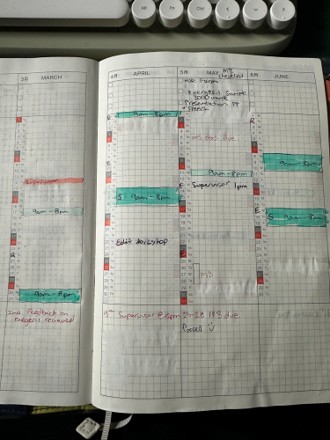
A future-log stand-in: teal blocks marking dedicated 9 am to 8 pm writing sessions, an MRes checklist, and supervisor meetings mapped out across March to June.
This spread is serving as Carroll’s future log, holding anything more than a month away, so it doesn’t get lost. However, it’s also doing something closer to a Gantt chart, the project-management tool named after Henry Gantt, who developed it as a way to lay out a project’s tasks as bars across a timeline (Master Academia, 2023). Gantt charts appear frequently in advice for doctoral and research students, precisely because they make milestones, dependencies, and deadlines visible at a glance rather than existing only in a supervisor’s email (Master Academia, 2023). One PhD candidate who kept hers on graph paper in a notebook rather than in project-management software made a point that resonates here: she’d jot questions, confusion, and notes for future directions right next to the bars, using her own shorthand symbols to mark progress in a way she describes as similar to bullet journaling (An Academic Planner, 2019). That’s more or less what the red “supervisor,” handwritten feedback dates, and small notes squeezed around my own colour blocks are doing.
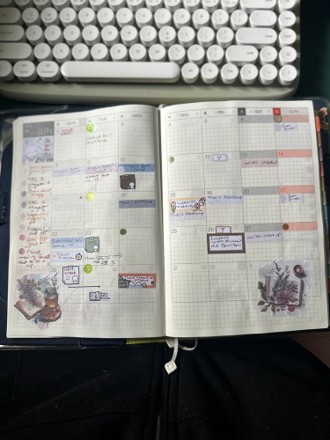
The monthly log, doing what Carroll intended: thesis bootcamp days, supervisor meetings, and an exegesis deadline boxed in black, alongside small self-care notes like a hair wash and salt scrub, and stickers marking a writer meetup.
This is the most literally Carroll-shaped of the four, a genuine monthly log that gives a one-page overview of the weeks ahead, so that deadlines and admin sit in the same field of view rather than scattered across separate systems.
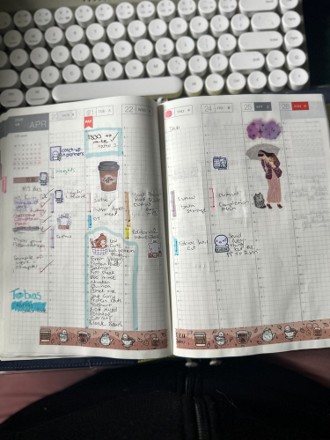
A weekly collection, hour by hour, with a running to-do list down the margin and a meal-planning list for the week folded in beside it.
The weekly hourly grid isn’t one of Carroll’s three original logs. It’s a custom collection, which is exactly the kind of addition the method is built to accommodate, since collections are simply any page given a topic and a purpose (Bullet Journal, 2023). This is where the day-to-day time-blocking actually happens: chapter revisions, dietitian appointments, and an editorial workshop each get their own hour rather than a vague place somewhere “this week.”
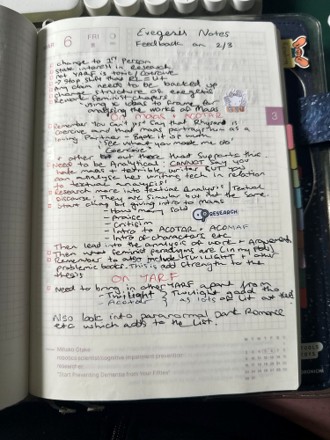
Rapid logging in practice: a daily notes page working through supervisor feedback on the exegesis, with red checkboxes as task bullets and a strike-through where an argument got dropped.
This page is closer to a daily log crossed with a working collection: a running list of feedback points as task bullets, a red pen used as an informal signifier for what still needs addressing, and a couple of lines struck through entirely once the argument inside them stopped being relevant. Migration essentially happens in real time rather than during a scheduled review.
Structure and softness, together
I think what I’ve landed on is that a good planning system needs to hold both of these things at once: enough structure to actually track a thesis, chapter deadlines, and supervisor meetings, and enough softness to acknowledge that a research degree is also just a season of your life, full of haircuts, rest days, tattoos, and writer meetups that deserve their own small mark on the page.
Writers on bullet journaling and wellbeing often frame the format’s real strength as this flexibility: the ability to include mood trackers alongside deadlines, gratitude spreads alongside deliverables, so that the planner reflects the whole of a season rather than only the productive parts of it (Headlight Health, 2024; Rosebud, 2025). One planning writer put it simply: if the enjoyment of a planning practice ever disappears entirely, or it starts to feel like a chore, that’s worth paying attention to and adjusting, because the point was never to perform productivity for its own sake (Manning, 2021).
For me, that’s the real test now. If a week goes by and I haven’t reached for the ink pads at all, it’s usually a sign that the week ran me rather than the other way around, and that’s worth noticing just as much as a missed deadline would be.
For me, the mushrooms in the margins aren’t a distraction from managing an MPhil. They’re what make it feel like something I’m shaping, page by page, rather than something just happening to me.
References
A Happy PhD. (n.d.). Time management. https://ahappyphd.org/tags/time-management/
An Academic Planner. (2019, January 13). Visualizing and tracking PhD tasks and progress with a Gantt chart. https://anacademicplanner.wordpress.com/2019/01/13/visualizing-and-tracking-phd-tasks-and-progress-with-a-gantt-chart/
Bullet Journal. (2023). What is the Bullet Journal method? https://bulletjournal.com/blogs/faq/what-is-the-bullet-journal-method
Danielle, M. (2026). The Bullet Journal method that organised my life does more than I thought it would. Mia Danielle. https://www.miadanielle.com/blog/the-bullet-journal-method-that-organized-my-life-does-more-than-i-thought
Hayton, J. (2024, April 16). Time management tips for PhD students. PhD Academy. https://phd.academy/blog/time-management-tips-for-phd-students
Headlight Health. (2024). Bullet journaling for wellness. https://headlight.health/bullet-journaling-for-wellness/
HelpGuide. (2026). Journaling for mental health and wellness. https://www.helpguide.org/mental-health/wellbeing/journaling-for-mental-health-and-wellness
ichorbio. (2024). 10 essential time management strategies for PhD students. https://ichor.bio/resources/10-essential-time-management-strategies-for-phd-students
Manning, T. (2021, September 28). 5 ways to bullet journal to benefit your mental health. Bullet Journal. https://bulletjournal.com/blogs/bulletjournalist/5-ways-to-bullet-journal-to-benefit-your-mental-health
Master Academia. (2023). Creating awesome Gantt charts for your PhD timeline. https://master-academia.com/phdtimeline-gantt-charts/
Rees, S. D. (2019, March 1). Bullet journaling for mental health. https://sarahdrees.co.uk/bullet-journaling-for-mental-health/
ResearchRabbit. (n.d.). PhD time management: Strategies to stay productive and balanced. Retrieved July 13, 2026, from https://www.researchrabbit.ai/articles/phd-time-management
Rosebud. (2025). Bullet journals: Prevent procrastination and boost productivity. https://www.rosebud.app/blog/bullet-journal
Self-Love Therapy LLC. (2024). The power of bullet journaling: A path to better mental health. https://www.self-love-therapyllc.com/post/the-power-of-bullet-journaling-a-path-to-better-mental-health
Tiny Ray of Sunshine. (2024). Thorough guide to the Bullet Journal system. https://www.tinyrayofsunshine.com/blog/bullet-journal-guide
Weagle, F. (2019, February 11). Using a bullet journal to improve your mental health. Coffee House Writers. https://medium.com/coffee-house-writers/bullet-journal-improve-mental-health-37c4b52c108a
Michelle Vokal is a Master of Philosophy (Media, Culture and Creative Arts) student at Curtin University.
Please make any anonymous comments/ feedback, or suggestions for further posts at this link. If you would like to get in touch, or write a post for the Ideas Hub blog, please email karen.miller@curtin.edu.au.
Photo by Ashlyn Ciara on Unsplash