GRASP
Mycelial thinking - What fungi (and Fungi People) can teach HDR students about research communities
August 12th, 2026, by
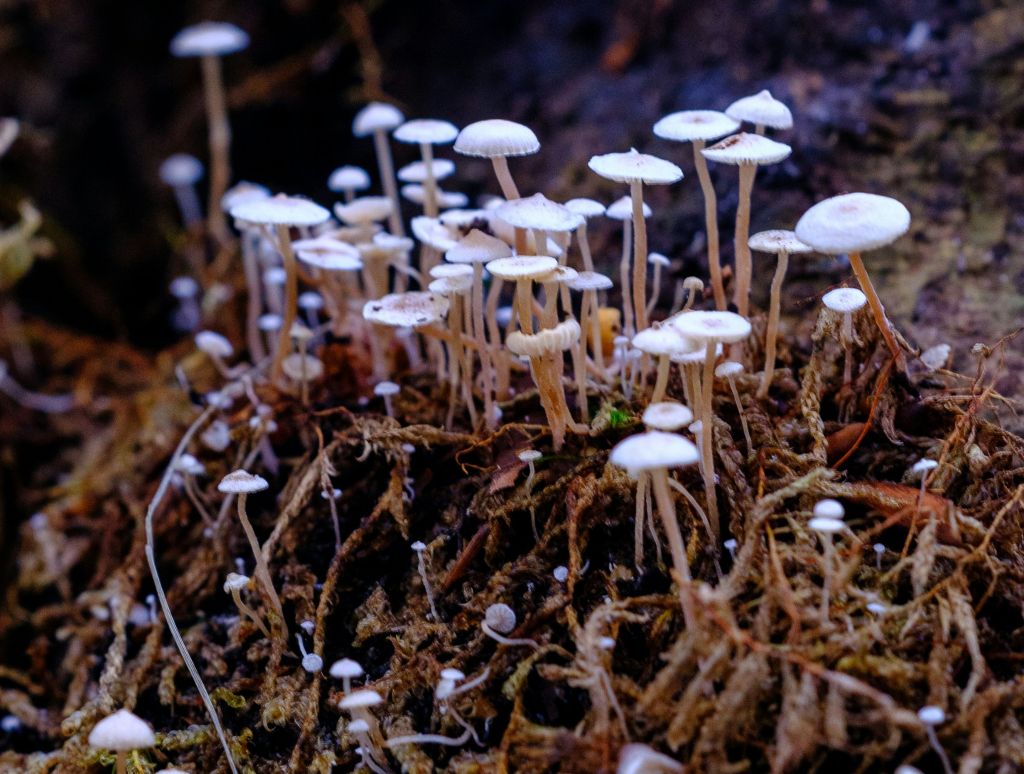
A confession before we start: I am the person who stops mid-hike to photograph a bracket fungus. I own more mushroom-print tote bags than is strictly defensible. I have mushroom-themed coffee mugs, keep cups, water bottles, pens, and desk decorations, and the list could go on; my stationery drawer is honestly starting to constitute its own small ecosystem.
So, when I first came across the idea of the “Wood Wide Web”, the theory that forests are laced together underground by sprawling fungal networks, quietly ferrying nutrients, water, and warning signals between trees, it didn’t land as a fun fact. It landed as a small identity crisis. Of course, the fungi are the real main characters of the forest. They always were. I have simply been walking around with a tote bag, waiting for the rest of the world to catch up.
As an HDR candidate, I’ve found myself returning to this metaphor more often than a mycologist returns to a rotting log, which is to say, compulsively, and usually with a torch and an unreasonable amount of enthusiasm. Doing a research degree, particularly remotely, can feel like a solitary pursuit: you, a laptop, and the low hum of imposter syndrome. However, look a little closer (get down on your hands and knees the way you would checking for chanterelles, ideally before someone else beats you to the patch). Most of us are sustained by something much less visible than a supervisor meeting or a conference presentation: a sprawling, quietly indispensable network of small, ongoing connections. Much like a forest floor.
The science briefly (a little Mycology for the uninitiated)
Mycorrhizal networks form when fungal threads called hyphae (think of them as the fungus’s very fine, very industrious fingers) grow into or around plant roots in a mutually beneficial relationship. The fungus extends the reach of a plant’s root system underground; in exchange, the plant shares sugars produced through photosynthesis, essentially paying rent in glucose, which is frankly a more reasonable arrangement than most share-house situations I’ve lived through. Where these hyphal threads connect multiple trees, they form what’s known as a common mycorrhizal network, or CMN, basically a subterranean group chat.
Forest ecologist Suzanne Simard’s research in the 1990s helped popularise the idea that older, larger “mother trees” act as central hubs in these networks, connected to many surrounding trees and seedlings, with resources moving among them along fungal pathways (National Forest Foundation, n.d.; Gabbatis, 2020). They are the botanical equivalent of the group-chat elder who always somehow remembers your candidature milestones before you do. Some researchers have pushed the metaphor further still, suggesting that the network’s structure bears a striking resemblance to neural networks, supporting something that looks a little like communication, learning, and memory at an ecosystem scale (Babar & Akan, 2024).
It’s worth saying, though, and this is the part that keeps even an obsessive fungi enthusiast appropriately humble, that this idea has also faced serious scientific pushback. A widely discussed 2023 review by three career forest-fungi researchers found that many of the more dramatic claims about tree “communication” and cooperation had outpaced what the underlying studies could support, and cautioned against letting the wood-wide-web narrative run ahead of the evidence (Jones et al., 2023). Even Simard’s own colleagues note that establishing a signal moving from one plant to another, let alone proving intent or communication, remains genuinely difficult to demonstrate (Gabbatis, 2020).
I think that tension is worth holding onto rather than smoothing over, because it’s part of what makes the metaphor useful for research communities too: connection is real, but it’s also easy to romanticise (guilty), and worth examining rather than simply assuming, the same way you’d actually check a mushroom against a field guide before eating it, rather than trusting vibes alone. (Do I need to state, please do not pick up random mushrooms to eat them? As much as I’d love to, some restraint is warranted - as an online student, my cat is my primary officemate, and while he is a wonderful companion, he is a genuinely terrible emergency contact, mostly interested in whether my sudden collapse means dinner will be served early).
What this has to do with HDR life
1. You don’t need a single central hub to be supported.
It’s tempting to think of your supervisor as the sole source of guidance and connection in a research degree, the way a small seedling might seem to depend entirely on the nearest big tree. However, in a mycorrhizal network, no single connection carries the whole load; resources move along many small, overlapping hyphal pathways. For HDR students, that might look like a Shut Up and Work session, an accountability chat group, a peer who reads your chapter drafts, or a monthly supervision meeting. None of these alone would be enough. Together, they behave less like a single taproot and more like the diffuse, redundant, quietly resilient mesh of a healthy mycelial mat. No single glorious oak required, just a lot of unglamorous threads doing their quiet, unphotogenic best.
2. Isolation is often about invisible infrastructure, not lack of effort.
A seedling planted somewhere without the right fungal partners nearby is simply cut off from a network everyone else can access, no fault of its own, no matter how hard it photosynthesises. Remote and off-campus HDR students often face something similar: the “infrastructure” of connection (hallway conversations, in-person events, casual check-ins) just isn’t there by default. That’s not a personal failing, and it’s not something discipline necessarily fixes. It usually means building alternative pathways deliberately, the way fungi send out exploratory hyphae in search of a new host, since the natural ones don’t reach you the way they reach people on campus.
3. Established researchers can pass resources downward if the network exists to carry them.
Simard’s research on “mother trees” preferentially supporting nearby seedlings (National Forest Foundation, n.d.) has an obvious echo in academia: senior researchers, supervisors, and near-completion students sharing time, feedback, and institutional knowledge with those coming up behind them. This only works, though, if those pathways exist and are actually used - a good argument for supervisors staying genuinely accessible, and for later-stage students mentoring earlier ones, rather than assuming support will simply trickle down through the soil on its own. Mother trees, it turns out, are not passive; they’re basically doing the mycological equivalent of forwarding you an opportunity with “thought of you!” attached.
4. Some of the most important exchanges are the quiet, unglamorous ones.
The nutrient exchange happening in a mycorrhizal network isn’t a dramatic event; it’s slow, constant, and almost entirely invisible from above ground, much like mycelium itself, which can spend years quietly threading through a log before a single mushroom ever pushes up through the leaf litter. The research equivalent might be the small, low-key touchpoints of an HDR degree: a five-minute check-in message, a shared Teams chat, a regular writing session with no agenda. These rarely feel like “milestones,” but they’re often what keep people fruiting, so to speak, between the actual milestone reviews. Fruiting bodies are the ones that get photographed and posted; the mycelium doing the actual work gets none of the likes, and yet here we all are, alive and occasionally thriving because of it.
5. Not everything that looks dead is actually finished doing work.
A great deal of fungal life is spent decomposing things: fallen leaves, rotting logs, whatever the forest has already given up on. What looks like waste to everyone else is, to a fungus, raw material. It gets broken down, absorbed, and quietly turned into the nutrients the next round of growth depends on. HDR life runs on the same principle more often than anyone admits. The abandoned draft chapter, the rejected conference abstract, the entire methodology you scrapped in year one, none of it was wasted, even though it felt that way at the time. It got broken down and folded into whatever your thesis has actually become. My cat treats every discarded printout as equally valuable, regardless of its academic merit, mostly as something to sit on, but he is, in his own way, onto something.
A caveat, deliberately (because even Mushroom People should show their working)
Given that part of my own research is about being wary of tidy, appealing narratives that outrun their evidence, it feels important to end on the same note as the scientists above: metaphors like this are useful for thinking, not as proof of anything (Jones et al., 2023). Research communities, like forests, are probably messier, more contested, and less neatly cooperative than any single metaphor suggests, and fungal networks themselves are stranger and more self-interested than the cosy “wood wide web” framing sometimes lets on (Pappas, 2023). However, messiness doesn’t cancel out the underlying point. Whether or not trees are quietly warning each other about drought, HDR students clearly do better when they’re not left to grow entirely alone, and neither, for what it’s worth, does a single spore, which is a genuinely comforting thought on the days that feel like you are standing alone in an empty clearing. Somewhere under the leaf litter, something is listening, and slowly, quietly, sending something back.
References
Arbtech. (n.d.). How forests communicate: Underground networks. Retrieved July 13, 2026, from https://arbtech.co.uk/how-forests-communicate/
Babar, A. Z., & Akan, O. B. (2024). Sustainable and precision agriculture with the Internet of Everything (IoE) (arXiv:2404.06341). arXiv. https://arxiv.org/abs/2404.06341
EcoMatcher. (n.d.). Understanding the wood wide web. Retrieved July 13, 2026, from https://www.ecomatcher.com/understanding-the-wood-wide-web/
Gabbatis, J. (2020, May 15). Can the wood-wide web really help trees talk to each other? BBC Science Focus Magazine. https://www.sciencefocus.com/nature/mycorrhizal-networks-wood-wide-web
Jones, M., Hoeksema, J., & Karst, J. (2023, May 25). Where the ‘wood-wide web’ narrative went wrong. Undark Magazine. https://undark.org/2023/05/25/where-the-wood-wide-web-narrative-went-wrong/
National Forest Foundation. (n.d.). Underground networking: The amazing connections beneath your feet. Retrieved July 13, 2026, from https://www.nationalforests.org/blog/underground-mycorrhizal-network
Pappas, S. (2023, February 28). Do trees really support each other through a network of fungi? Scientific American. https://www.scientificamerican.com/article/do-trees-support-each-other-through-a-network-of-fungi/
Michelle Vokal is a Master of Philosophy (Media, Culture and Creative Arts) student at Curtin University.
Please make any anonymous comments/ feedback, or suggestions for further posts at this link. If you would like to get in touch or write a post for the Ideas Hub blog, please email karen.miller@curtin.edu.au. Contributions from HDR students are welcome!
Image by JHaberdoedas from Unsplash.